Setting Your Makeup with HD Powder
Under the heat of the spotlights or in front of an ultra-high-definition camera lens, stage makeup leaves no room for error. The entertainment industry operates in a visual environment where texture flaws can easily show up on screen. One of the most persistent promises in dressing rooms remains the miracle powder, supposed to mattify the complexion without ever betraying its presence under the flashes. Yet, the way powder actually behaves on the skin proves otherwise.
Applying powder is not just a simple cosmetic step; it is an interaction between light and matter. Blindly relying on a commercial label can ruin your visual presentation during a major event. Today's challenge is no longer about finding the perfect product and hoping it works, but rather about adopting a strict application method and a rigorous testing protocol. For musicians, performers, and image professionals, mastering one's appearance requires abandoning the myth of a universal solution in favor of a technical understanding of the interactions between formulas, tools, and optical sensors.
Key Takeaways
- Terminology matters: Setting powders lock makeup in place, while HD powders blur surface details for video capture.
- The universal myth: The anti-glare effect depends on the chemistry of both the makeup base and the lighting.
- Representative testing: Testing your makeup requires reproducible conditions across several representative skin tones and bases.
- The 4K diagnosis: High definition reveals texture and roughness far beyond a simple white cast.
On-Set Glossary: Setting, Finishing, or HD Powder?
Amidst the hustle and bustle of preparing for a concert or a shoot, makeup artists' kits are overflowing with powders making all sorts of claims. This abundance creates technical confusion that can compromise the final result. According to Colorescience's commercial literature, distinguishing the exact functions of each formula is essential to structuring your routine correctly.
The Hierarchy of Powder Products
Each powder comes into play at a specific moment and addresses a distinct need on the skin.
- Setting powder: Often used to lock in liquid or cream foundation as its primary function. It acts as a barrier that absorbs excess sebum and prevents pigments from shifting.
- Finishing powder: Applied over completed makeup. Its role is optical, designed to blur fine lines and smooth the appearance of enlarged pores.
- HD powder: This is a specific subset of finishing powder. Formulated for people who are regularly photographed or filmed in high definition, it can also double as a base setting powder, thereby avoiding the need to stack two layers of product.
Usage Comparison Chart
| Type of powder | Main function | Place in the routine |
|---|---|---|
| Setting | Locks in foundation and absorbs sebum | Directly over wet textures |
| Finishing | Blurs fine lines and pores | As a final perfecting step |
| High Definition (HD) | Optimizes the look under harsh lighting; can also act as a setting powder | Over the entire makeup |
Debunking the Myth: The Anatomy of a "Flashback"
The cosmetics industry has long maintained the illusion that simply using a screen-ready product guarantees a flawless complexion. HD powder is touted as a way to prevent camera flashback—those dreaded white patches that appear in photos when a flash reflects off foundation particles. However, analytical guides published by L&J Cosmetics qualify this promise, demonstrating that the issue actually stems from the overall ecosystem involving lighting, tools, and the makeup base.
The Physical Reality of the Phenomenon
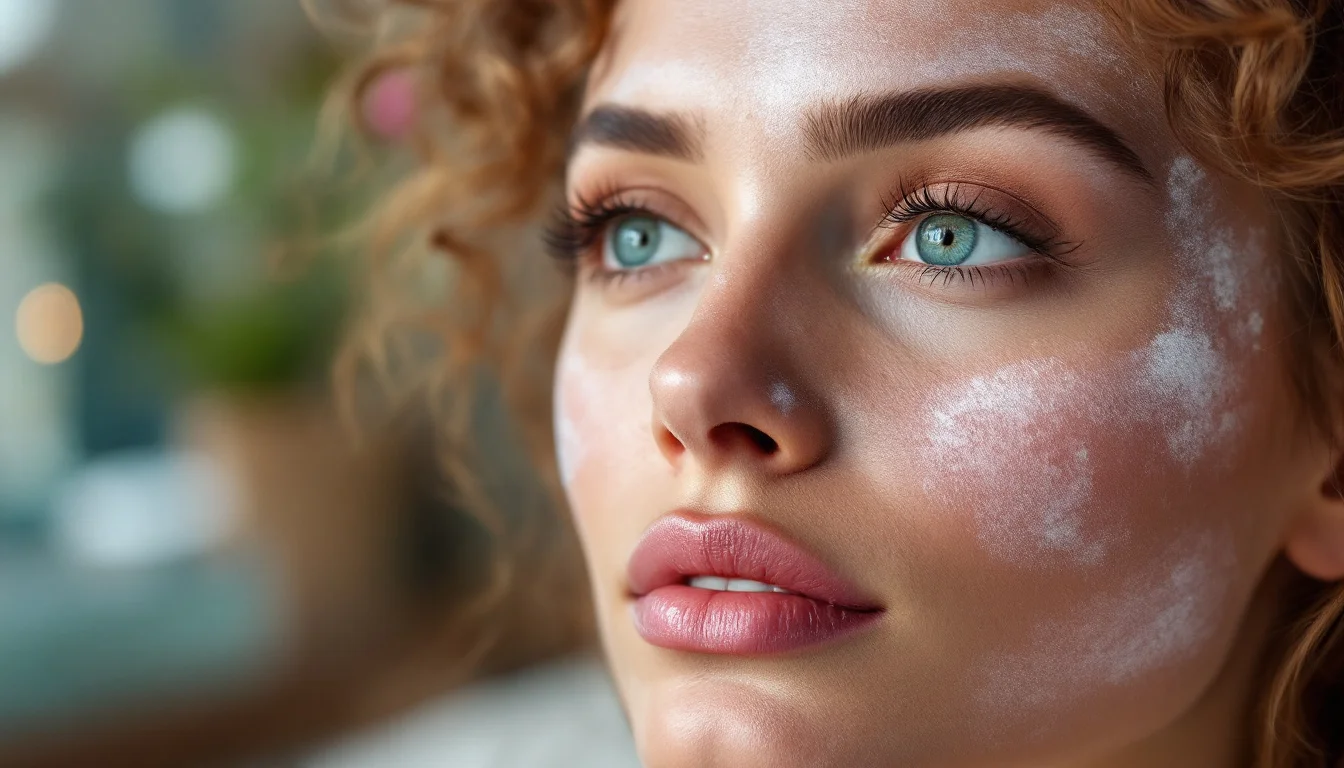
Setting powder flashback is characterized by a bright or chalky appearance visible in a captured image. This effect shows up wherever the product has accumulated in excess: under the eyes, in the center of the face, or on naturally prominent areas like the cheekbones and the bridge of the nose.
This phenomenon does not stem from a single cause. Analyses reveal a combination of factors:
- A powder shade that is too light compared to the foundation base.
- A microscopic deposit that is too visible on the surface of the skin.
- An application method that overly concentrates the product.
- A highly reflective finish that behaves differently in front of a camera sensor.
The Chemistry of Stage Glare
The composition of powders plays a major role in how they behave under the spotlight. Mica is a mineral filler with a particularly reflective, layered structure that adds shine to loose powders. Illuminating creams and powders routinely use reflective ingredients like titanium dioxide and mica, often paired with texture-controlling agents.
It is the collision between these reflective minerals and a camera flash or stage spotlight that can create a mask-like effect. Given this chemistry, no formula can honestly be touted as universally "flash-proof." In fact, it is impossible to predict flashback solely from an ingredient list: the formula's balance, concentration, particle treatment, the amount applied, and the overall complexion base must all be sample-tested. A manufacturer's claims should be limited to what has been rigorously tested (an absorbent, lightweight, and refined finish), and cannot be spun into a blanket guarantee for all skin tones, camera settings, hydrating bases, and application quantities.
The Engineering of Application: Choosing the Right Tool and Format
Preventing flashback starts before you even face the stage lights; it all comes down to selecting the right formats and instruments.
Adapting the Format to Your Skin Type
A powder's behavior depends on the lipid levels present on the performer's skin. Pressed powder is often pitched as being suitable for dry skin. Conversely, loose powder is frequently recommended for oily skin types, though this distinction is a broad generalization; the final result depends more on the formulation (absorbent agents, binders) than on the format itself. The ultimate choice also depends on the intended use—touch-ups, under-eye setting, all-over shine control, or on-camera performance—and must be validated by a test tailored to each specific format.
The Impact of Makeup Tools
Underestimating the impact of your applicator is a rookie mistake in the dressing room. Your choice of tool dictates the amount of product deposited and alters the final look:
- The powder puff: Firmly presses the product into still-tacky concealer.
- The sponge: Often used damp, its finish heavily depends on technique and the amount of product picked up; overusing the powder quickly leads to a cakey effect.
- The fluffy brush: Deposits a light, controlled veil of product, minimizing the concentration of reflective pigments.
Strategic Application Timing
It is best to sweep on a fine layer of powder using a fluffy powder brush only after completing all liquid makeup steps (foundation, contour, highlighter). Applying powder between wet steps ruins the seamlessness of the complexion. Finally, keeping your equipment impeccably clean is essential; washing your brushes regularly prevents the buildup of saturated residue.
The Crash-Test Protocol: How to Validate Your Complexion Before Filming
Anticipation is a highly effective defense against unexpected technical hiccups during a video shoot. Relying on a quick glance in the dressing room mirror is simply not enough. It is imperative to establish a strict validation protocol structured around proper evaluation methods.
Step 1: Evaluation on Representative Bases
Validating a powder cannot be done solely on bare skin or a single skin tone. The powder must be evaluated on, at a minimum, representative light, medium, and dark bases. A quick beige swatch test on an arm skews the diagnosis, as the contrast and undertone of the base radically alter the result visible through the lens.
Step 2: Standardizing the Variables
An actionable camera test requires strictly reproducible conditions. To ensure the reliability of the crash test, the protocol must document and control every parameter:
- A consistent amount of foundation and concealer.
- A set resting time before powdering.
- An identical amount of powder applied per zone.
- Locked camera exposure settings (white balance, distance, stable background).
- Mandatory angles: frontal view, slight three-quarter turn, and targeted close-ups on the under-eye area as well as the T-zone.
Step 3: Texture Analysis in 4K
Analyzing the images from a crash test must go far beyond merely looking for the classic white cast. A thick layer of powder, rough texture around dry patches, or a stark demarcation between powder and concealer can glaringly show up on a 4K screen, even if they remain completely invisible in a standard photograph. Consequently, a sample might perfectly avoid pale flashback, yet be categorically rejected if it makes the complexion look visibly dry and parched.
Frequently Asked Questions (FAQ) About HD Powder and Cameras
Is a simple phone picture enough to test 4K makeup?
No. On many devices using default settings, smartphone image-processing algorithms automatically smooth out flaws and compensate for exposure. A video recording done under stage lighting, with a camera that disables smoothing filters, is much more effective at detecting pigment clusters and texture demarcations specific to professional shoots. A phone photo can support the review process, but it is not enough on its own to validate makeup destined for 4K.
Can HD powder be used for everyday makeup?
Technically yes, but proceed with caution. Formulas designed to withstand the heat of a film set are exceptionally absorbent. Used on a daily basis without the benefit of stage lighting to soften facial contours, they risk settling into fine lines and creating a visibly dry appearance on skin exposed to natural daylight.
Conclusion: The Era of Texture Management
The entertainment industry is operating in an era where colorimetry alone is often no longer enough to guarantee a flawless image. Faced with the precision of modern optical sensors, color correction has given way to hyper-precise texture management. The challenge for artists and their teams lies in their ability to tame the behavior of the product so that it seamlessly melts into the skin, creating an illusion of natural beauty capable of surviving the unforgiving test of ultra-high definition.